St Mary'sC of E Primary School
Behaviour
Zones of Emotional Regulation
Learning, Transforming and Growing
At St. Mary’s, we recognise the importance of promoting positive mental health and emotional wellbeing to our children and their families. We aim to create an open culture around the discussion of mental health and wellbeing and to empower our children be able to regulate their emotions. By implementing the Zones of Regulation curriculum we aim to teach our pupils to identify emotions in themselves and others and provide them with a bank of strategies to help them to regulate their emotions and improve their wellbeing.
There is progression across the curriculum with children in Early Years learning to identify different emotions to children in Upper Key Stage 2 discussing how our behaviour can impact upon the feelings of those around us.
What is The Zones of Regulation?
The Zones of Regulation is a curriculum full of a range of activities to help your child develop skills in the area of self-regulation. Self-regulation can go by many names, such as self-control, self-management and impulse control. It is defined as the best state of alertness of both the body and emotions for the specific situation. For example, when your child plays in a football match, it is beneficial to have a higher state of alertness. However, that same state would not be appropriate in the local library.
Some of the aims of The Zones of Regulation:
- To help children recognise when they are in the different Zones and how to change or stay in the Zone they are in.
- To gain an increased vocabulary of emotional terms so that they can explain how they are feeling.
- To gain insight into events that might make them move into the different Zones e.g. disagreement with a friend, a certain subject being taught or a fire drill.
- To help children understand that emotions, sensory experiences, physiological needs (e.g. hunger/lack of sleep) and environments can influence which Zone they are in.
- To develop problem-solving skills.
- To identify a range of different calming and alerting strategies/tools that support them. Tools identified may be personalised sensory supports (e.g. use of putty at key times), calming techniques or thinking strategies.
The Zones can be likened to traffic lights:
Green: you are ‘good to go!’
Yellow: slow down or take warning
Red: stop and regain control
Blue: rest area where you pull over when you’re tired and need to recharge.
How can you help your child use The Zones of Regulation?
- Identify your own feelings using Zones language in front of your child (e.g. “I’m frustrated, I think I am in the Yellow Zone.”)
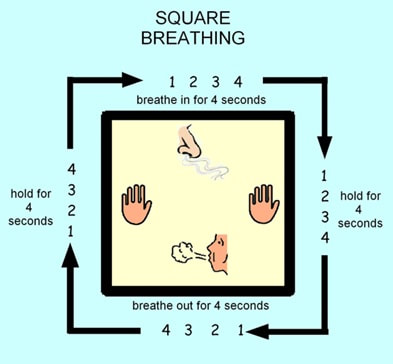
- Talk about what tool you will use to be in the appropriate Zone (e.g. “I need to take 4 deep breaths to help get me back to the Green Zone.”)
- At times, wonder which Zone your child is in. Or, discuss which Zone a character in a film/book might be in (e.g. “You look sleepy, I wonder if are you in the Blue Zone?)
- Engaging your child in discussion around Zones when they are in the Red Zone is unlikely to be effective. You need to be discussing the different Zones and tools they can use when they are more regulated/calm.
- Teach your child which tools they can use (e.g. “It’s time for bed, let’s read a book together in the rocking chair to get to the Blue Zone”).
- Share how their behaviour is affecting your Zone. For example, if they are in the Green Zone you could comment that their behaviour is also helping you feel happy/go into the Green Zone.
- Put up and reference the Zones visuals and tools in your home.
- Praise/encourage your child to share which Zone they might be in.
It is important to note that everyone experiences all of the Zones – the Red and Yellow Zones are not the ‘bad’ or ‘naughty’ Zones. All of the Zones are expected at one time or another.
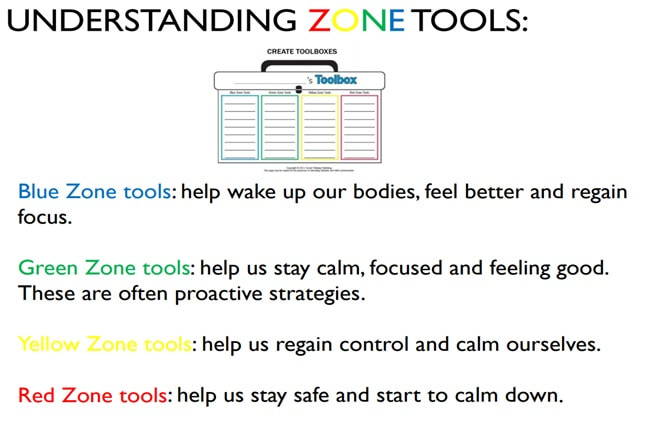
As part of our learning about the Zones of Regulation, we encourage children to choose ‘tools’ to go in their toolkits.Tools aren’t just for school: they can be used at home too. You too can help your child to regulate (manage) their emotions.
Read through some of the strategies below to decide what would go in your Zones of Regulation toolkit? Think about:
- What helps you to calm down when you are stressed?
- What helps you to focus when you are tired?
- What do you do to calm down when you are angry?
Different tools work for different people. You can help your child choose what works for them when they need to move from one zone to another. Sensory tools include anything which you can see, touch/feel, smell, hear or taste. They also are things which encourage you to move.

- Having a bear hug
- Using a wobble cushion
- Using a weighted toy or blanket
- Ear defenders / headphones
- Blowing bubbles
- Watching changing coloured lights
- Soft, dimmed lighting
- Fidget and squeezy toys or putty
- Smelling relaxing scents like Lavender
- Eating chewy food
- Swinging or rocking
- Eating a strong mint
- Wall push-ups
- Sucking a smoothie or milkshake through a straw
- Roll on a balance ball
- Listen to classical music
- Have a dance
- Jumping on a trampoline
- Having a nice warm bath
- Listening to bird / nature sounds
- Going for a walk or run
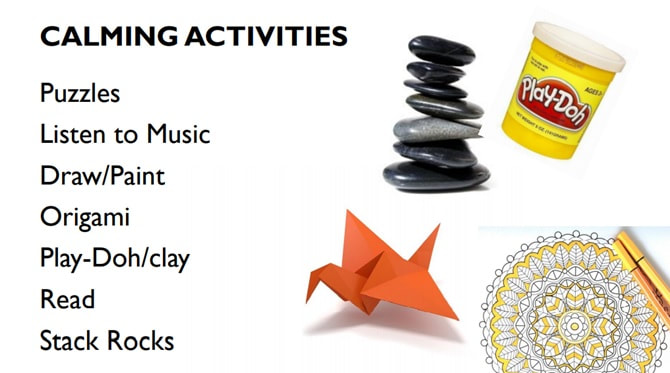
These include any activities which distract you or need you to focus to take your mind off worries and negative thoughts.
Thinking techniques
These are strategies to challenge negative thoughts and help a child to deal with problems.
Make sure you frequently praise your child for having expected reactions rather than just pointing out the unexpected reactions.

Breathing techniques
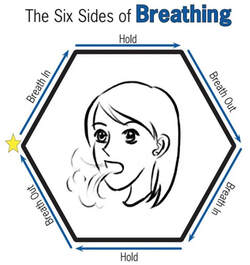
Starting at the star, trace with your finger the sides of the hexagon as you take a deep breath in, feeling your shoulders rise as the air fills you. Trace over the next side as you hold your breath for a moment. Slowly breathe out as you trace the third side of the hexagon. Continue tracing around the bottom three sides of the hexagon as you complete another deep breath. Continue the Six Sides of Breathing cycle until you feel calm and relaxed.
Grounding Techniques
Grounding techniques can help someone who is extremely anxious or scared, has lost control and is struggling to calm down.
5-4-3-2-1 Senses
Identify:
-
5 things you see
-
4 things you hear
-
3 things you smell
-
2 things you can touch
-
1 thing you taste
5-4-3-2-1 Sights
If noticing each sense is tough right now, try an exercise just with sights. Create categories and have them name what they see. Here’s an example:
-
5 colours I see
-
4 shapes I see
-
3 soft things I see
-
2 people I see
-
1 book I see
A-B-C Around the Room
This exercise will get the child connected with that place where they are right now. Have your child look around the room and name something they see that starts with A, then B, then C and so forth. See how far they can get through the alphabet and then check-in to see how they’re feeling once they reach the end.
Object Focus
Keep some unique items on hand with different textures and colours. These could be sensory items, colourful rocks, snow globes or something else. Children can hold an item in their hands and tune in all of their focus to the item. Notice the colours. Notice the textures. How does it feel in my hand? How does it feel when I squeeze it? What colours do I see? Just notice everything there is to notice about the item!
‘I am Here’ Hand Trace
For this exercise, you’ll need paper and a pencil, marker, or crayon. Children will trace a hand on the paper. You can take this a few different directions. Children can simply press the hand into the space on the paper and feel the connection between hand and table. Alternatively, they can use the space inside the hand to write things they see or describe the room.
Reorientation
To re-orient to the moment, just have the child name facts about the moment. You can give them a card to keep with them to remind them of facts they can state and practice, practice, practice! It might sound like:
- My name is…
- I am in…
- Today is…
- The season is…
- The weather is…
- I am wearing…
Room Search
Pick one broad category and search the room. Name everything in the room that is green. How many stars can you find in the room? Say the type of shoe everyone in the room is wearing. Count the bricks on one wall.